






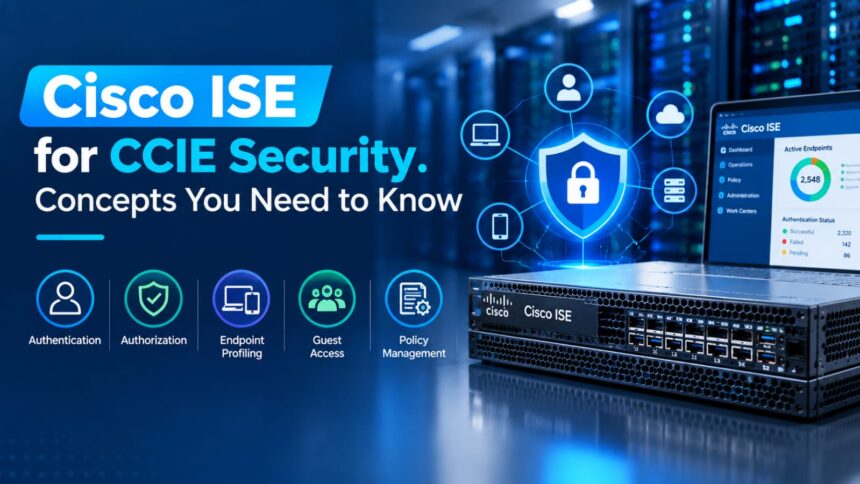
Cisco ISE concepts are essential for understanding identity-based access control and security policy management in modern enterprise networks. Cisco Identity Services Engine (ISE) helps organizations authenticate users and devices, enforce access policies, and improve network visibility through centralized identity and endpoint management. It supports technologies such as 802.1X, RADIUS, endpoint profiling, guest access, and policy-based authorization, making it an important platform for network security professionals.
For professionals who want to do CCIE Security training, learning Cisco ISE concepts can strengthen their understanding of authentication, authorization, identity-based access, and secure network design. This introduction explores the core capabilities of Cisco ISE and explains why understanding these concepts is valuable for building practical enterprise security skills.
What Is Cisco ISE?
Cisco Identity Services Engine is a network access control and policy platform designed to control who and what can access enterprise resources.
ISE can collect information about users and endpoints and use that information to determine the level of network access they should receive. It integrates with technologies such as 802.1X, RADIUS, Active Directory, certificates, wireless networks, switches, and security infrastructure.
For CCIE Security professionals, Cisco ISE is particularly relevant because it connects several security concepts into a centralized policy framework.
Instead of simply asking whether a device is connected to the network, organizations can use ISE to answer questions such as
- Who is connecting?
- What device are they using?
- Is the device compliant?
- Where is the connection coming from?
- What level of access should be provided?
- Should the connection be restricted or denied?
These capabilities make ISE an important component of identity-based network security.
Why Cisco ISE Matters for CCIE Security
Network security is increasingly based on identity and context rather than only IP addresses and network locations. Cisco ISE provides the policy and identity capabilities required for this approach.
For CCIE Security candidates, learning ISE helps connect theoretical security concepts with practical enterprise deployments.
Some of the major areas include
- Identity-based access control
- Authentication and authorization
- 802.1X
- RADIUS
- Network Access Control
- Endpoint profiling
- Guest access
- Posture assessment
- Security Group Tags
- Policy enforcement
- Integration with other security platforms
Understanding these concepts can also help security professionals troubleshoot authentication failures and access-control problems in production networks.
Core Cisco ISE Concepts to Understand
1. Authentication
Authentication determines whether a user or device is who it claims to be.
Cisco ISE can authenticate network users and endpoints using different methods. Common examples include:
- Username and password
- Digital certificates
- 802.1X authentication
- RADIUS
- Active Directory integration
In an enterprise environment, authentication commonly involves a supplicant, an access device such as a switch or wireless controller, and ISE acting as the authentication server.
A basic flow can look like this:
Endpoint → Switch/Wireless Controller → Cisco ISE → Identity Source
Understanding this process is important when studying network access control.
2. Authorization
Authentication answers, “Who are you?”
Authorization answers “What are you allowed to access?”
After successfully authenticating an endpoint or user, Cisco ISE evaluates configured policies and determines what access should be provided.
For example, an employee’s corporate laptop might receive normal internal network access, while a guest device could be placed into a restricted guest network.
Authorization can use information such as
- User identity
- Device type
- Authentication method
- Network location
- Security group
- Endpoint attributes
- Compliance information
This makes authorization one of the most important concepts to understand when working with ISE.
3. 802.1X
802.1X is a port-based network access control mechanism widely associated with enterprise authentication.
A typical 802.1X deployment includes three components:
| Component | Function |
| Supplicant | Endpoint requesting network access |
| Authenticator | Switch or wireless device controlling access |
| Authentication Server | Cisco ISE validating authentication requests |
The endpoint communicates with the authenticator using EAPOL. The authenticator then communicates with ISE using RADIUS.
Understanding this architecture is essential for troubleshooting authentication and authorization issues.
4. RADIUS
RADIUS is a key protocol used by Cisco ISE for centralized authentication, authorization, and accounting.
In many enterprise deployments, network devices such as switches, wireless controllers, and VPN infrastructure send authentication requests to ISE.
A simplified process is:
User/Device → Network Device → RADIUS → Cisco ISE → Identity Store
Learning how RADIUS requests and responses work helps security engineers diagnose problems such as rejected authentication requests, incorrect policies, or communication failures between network devices and ISE.
Cisco ISE Policy Sets
Policy sets are central to how Cisco ISE processes access requests.
A policy set can define the conditions under which a particular group of authentication and authorization policies should apply.
For example, an organization could create policies for:
- Corporate wired users
- Corporate wireless users
- Guest users
- Contractors
- Network administrators
- IoT devices
ISE evaluates incoming requests against policy conditions and applies the appropriate authentication and authorization rules.
When preparing for advanced network security responsibilities, understanding how policy conditions, authentication policies, and authorization policies interact is more useful than simply memorizing configuration commands.
Endpoint Profiling
Not every endpoint connecting to an enterprise network is necessarily a traditional employee computer.
Organizations may have:
- IP phones
- Printers
- Cameras
- IoT devices
- Smartphones
- Laptops
- Tablets
- Industrial devices
Cisco ISE can use endpoint information to identify and classify devices through profiling mechanisms.
For example, an endpoint could be identified as an IP phone and assigned an appropriate network policy.
This provides organizations with greater visibility and enables more granular access control.
Guest Access
Cisco ISE can also support guest network access.
Guest users typically need internet connectivity without receiving the same privileges as internal employees.
ISE provides capabilities for managing guest identities and applying appropriate access policies.
A typical guest architecture may involve:
Guest Device → Wireless Network → ISE → Guest Portal → Authorization Policy
Organizations can configure guest access according to their security requirements, including authentication methods, access duration, and network restrictions.
Security Group Tags and TrustSec
Cisco ISE can also work with Cisco TrustSec technologies, including Security Group Tags (SGTs).
Instead of relying entirely on traditional IP-based access lists, SGTs can help associate traffic with security identities or groups.
For example, different groups could represent:
- Employees
- Servers
- Contractors
- Guests
- IoT devices
Policies can then control communication between these groups.
For advanced security engineers, understanding identity-based segmentation is valuable because it demonstrates how network access policies can evolve beyond traditional VLAN and IP-based approaches.
Cisco ISE and Active Directory
Many organizations use Microsoft Active Directory as an identity source.
Cisco ISE can integrate with Active Directory to authenticate users against existing organizational identities.
This can help organizations avoid maintaining completely separate user databases for network authentication.
The integration also allows policies to use identity-related information when determining access.
When troubleshooting an ISE deployment, engineers should understand the relationship between ISE, Active Directory, authentication protocols, and network devices.
Cisco ISE and Zero Trust
Zero Trust security is based on the principle that access should not automatically be trusted simply because a user or device is inside the corporate network.
Cisco ISE can support Zero Trust-oriented strategies by providing identity and endpoint context for access decisions.
For example, network access can consider:
Identity + Device + Location + Authentication + Security Policy
This allows organizations to make more granular access decisions rather than relying solely on network location.
Common Cisco ISE Challenges
Cisco ISE deployments can become complex because multiple components must work together.
Common challenges include:
- Incorrect authentication configuration
- RADIUS communication problems
- Certificate issues
- Active Directory integration problems
- Incorrect authorization policies
- 802.1X configuration errors
- Endpoint profiling inaccuracies
- Network device configuration problems
- Incorrect policy conditions
Troubleshooting therefore requires an understanding of the complete authentication flow rather than focusing on ISE alone.
How to Learn Cisco ISE Effectively
A practical learning approach should combine theoretical concepts with hands-on configuration and troubleshooting.
Start by understanding:
- Network authentication fundamentals
- RADIUS and TACACS+
- 802.1X and EAP
- Cisco ISE architecture
- Authentication and authorization policies
- Policy Sets
- Endpoint profiling
- Guest access
- Security Group Tags
- Troubleshooting and logging
Hands-on labs can then be used to simulate real enterprise scenarios. Building authentication policies, connecting network devices to ISE, testing endpoint access, and troubleshooting failed authentication requests can provide practical experience.
Conclusion
Cisco ISE plays an important role in identity-based network access control and enterprise security. Its capabilities around authentication, authorization, endpoint profiling, guest access, policy enforcement, and identity-based segmentation make it a valuable technology for modern security environments.
For professionals preparing for advanced Cisco security roles, understanding these concepts is more valuable than learning isolated commands. A structured CCIE Security Course program combined with hands-on labs can help learners connect Cisco ISE concepts with broader network security architectures and real-world troubleshooting scenarios.